
Hello, this is Miyabi. Today, let’s learn about the meaning of 「ごはん」.
「ごはん」 as a meal
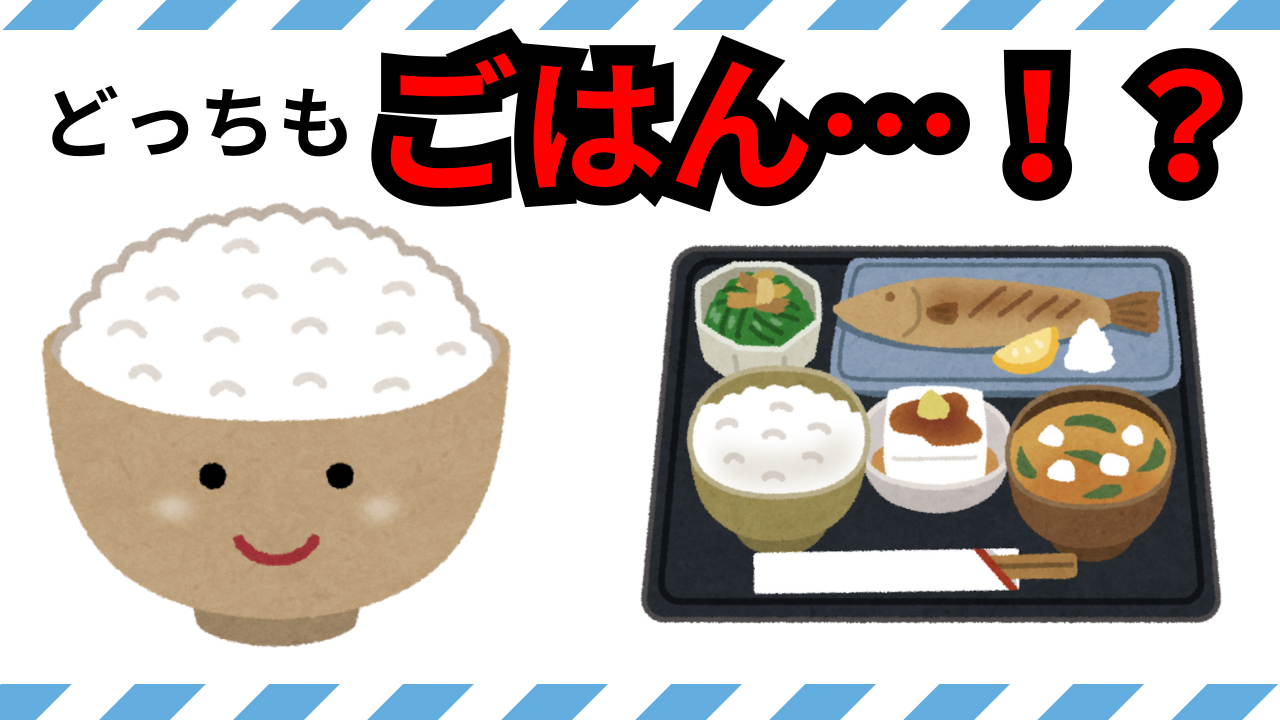
In Japanese, we use the word 「ごはん」 in expressions like 朝ごはん, 昼ごはん, and 夜ごはん.
For many learners, it seems natural to understand 「ごはん」 as a meal.
「ごはん」 also means cooked rice
However, things get a little tricky because 「ごはん」 also means cooked rice—the plain rice served at Japanese tables.
This can be confusing for learners, because the same word carries two different meanings.
So how can you tell whether 「ごはん」 means a meal or white rice?
So how can you tell whether 「ごはん」 means a meal or white rice?
The answer is simple: 文脈(context).
When 「ごはん」 Means “a Meal”
Imagine a child playing with toys.
The mother calls out:
「ごはんよ」
In this situation, the meaning is clearly a meal is ready.
No Japanese person would interpret this as “white rice is ready.”
The context makes the meaning unmistakable.
When 「ごはん」 Means “Rice”
Now consider a different scene.
The mother has already placed dishes like sausage and 卵焼き(tamagoyaki) on the table.
Then she asks:
「ごはんにする? パンにする?」
Here she is asking:
“Do you want rice or bread as your main staple?”
In this case, 「ごはん」 unambiguously means white cooked rice, not a full meal.
Japanese Depends Heavily on Context
As you can see, Japanese often relies on context to convey meaning.
Subjects are frequently omitted, and many expressions are intentionally vague.
This can be challenging at first, but it’s also part of what makes the language unique and interesting.
If you’d like to explore these nuances more deeply, feel free to learn together with me on YouTube.

I also have a video specifically explaining the phrase 「ごはん」, so please check it out.